Building Production-Ready AI Copilots: Architecture, Guardrails, and Scale
Most AI copilots work well during demonstrations but struggle in production. This article explains what changes when an AI copilot must support real users, enterprise data, and business-critical workflows, and why architecture matters as much as the language model itself.
Most AI copilots work well during demonstrations but struggle in production. This article explains what changes when an AI copilot must support real users, enterprise data, and business-critical workflows, and why architecture matters as much as the language model itself.
Ask almost any engineering team about their AI roadmap and "AI copilot" will appear near the top of the list. Building a prototype is no longer the difficult part. Modern language models, orchestration frameworks, and managed AI services have significantly lowered the barrier to entry.
Production deployment is a different challenge.
An AI copilot must retrieve enterprise knowledge, protect sensitive information, follow organizational policies, integrate with existing systems, and remain reliable under continuous usage. The language model becomes only one component of a much larger architecture.
That shift changes how engineering teams should approach AI copilot development. Success depends less on writing better prompts and more on designing systems that remain accurate, secure, observable, and scalable as usage grows.
1. Why most AI copilots fail after the demo
Many AI copilot projects begin with a simple objective: answer questions using company knowledge.
The first version often performs well because the dataset is small, the number of users is limited, and the questions are predictable. Developers already understand the documents being indexed, making it easier to judge whether responses are correct.
The situation changes once the copilot is introduced to a larger audience.
Different teams ask different questions. Documentation grows every week. Access permissions become more complicated. New data sources are added, and users begin expecting consistent answers regardless of where the information originates.
The architecture that worked for a proof of concept starts showing weaknesses.
Some of the most common production issues include:
- inconsistent retrieval results across multiple knowledge sources
- outdated information appearing in responses
- permission boundaries not being enforced correctly
- increasing response latency as documents grow
- limited visibility into why the copilot generated a particular answer
These problems rarely originate from the language model itself. They usually stem from the systems surrounding it.
A production AI copilot should be viewed as a distributed software system rather than a chatbot. Retrieval, orchestration, security, monitoring, caching, and governance all contribute to the quality of every response.
2. What makes an AI copilot production-ready?
A production-ready AI copilot is designed to operate within the same engineering standards expected from any business-critical application.
Instead of asking, "Can the model answer this question?", engineering teams should ask broader questions.
Can the copilot retrieve the correct information every time?
Can it explain where an answer came from?
Can administrators understand why a response failed?
Can the system continue operating as the knowledge base grows from thousands of documents to millions?
These questions define production readiness.
A mature AI copilot generally consists of several independent components working together.
| Component | Primary Responsibility |
| User Interface | Accept user requests and display responses |
| Orchestration Layer | Coordinate workflows and tool execution |
| Retrieval Layer | Find relevant enterprise knowledge |
| Large Language Model | Generate contextual responses |
| Guardrails | Enforce safety, policy, and validation |
| Monitoring Platform | Track quality, latency, and system health |
Separating these responsibilities provides two important advantages.
First, individual components can evolve independently. A team may replace one language model with another without redesigning the retrieval pipeline.
Second, failures become easier to diagnose. If response quality decreases, engineers can determine whether retrieval, orchestration, or inference is responsible instead of treating the copilot as a black box.
3. A reference architecture for enterprise AI copilots
Production AI copilots rarely interact with a single knowledge source. Most organizations maintain information across documentation platforms, ticketing systems, databases, cloud storage, collaboration tools, and internal applications.
The copilot architecture should accommodate this complexity from the beginning.
A typical request follows a sequence similar to this:
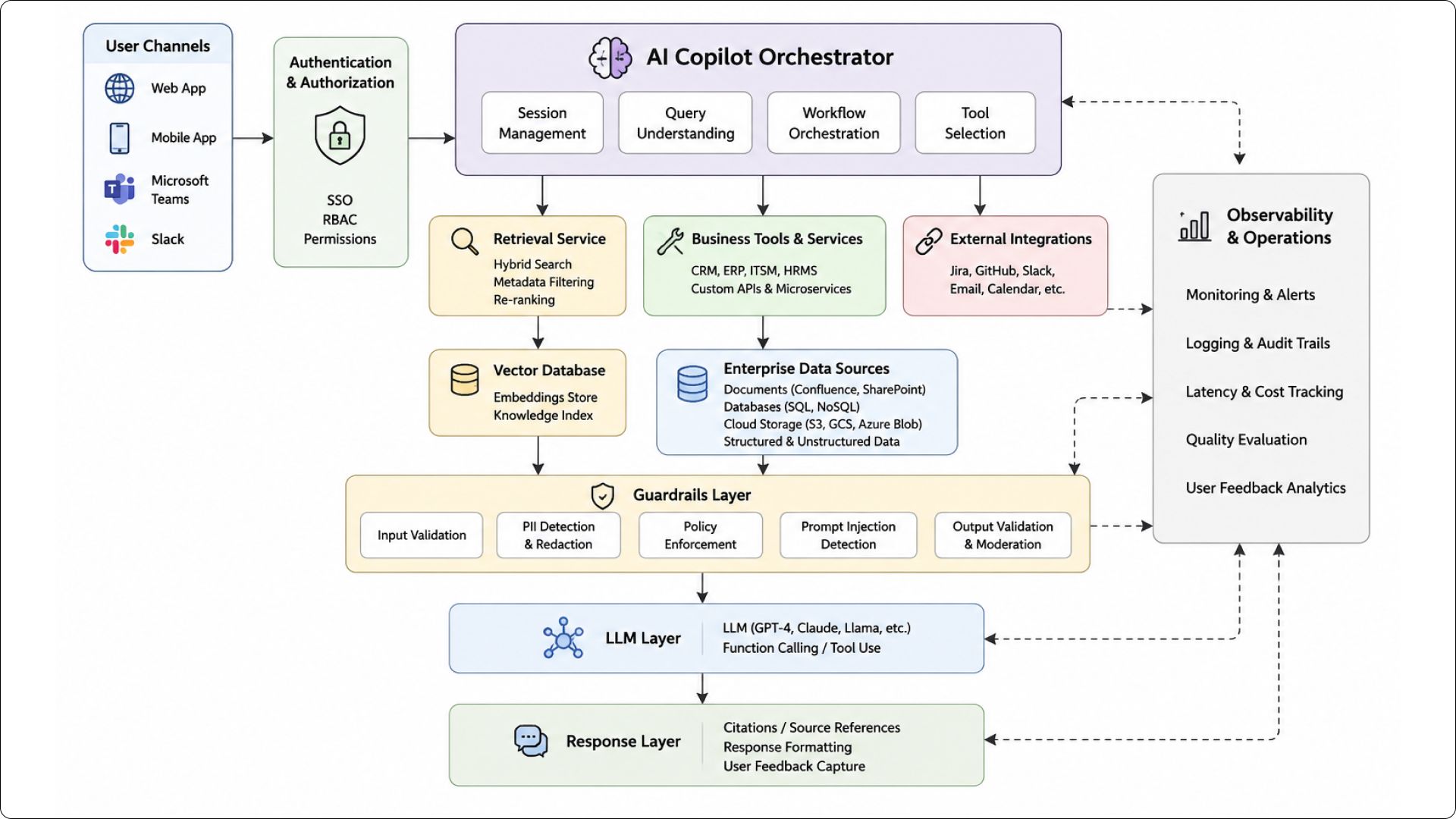
Each layer performs a specific responsibility.
Authentication verifies user identity before retrieval begins. The orchestration layer determines which enterprise systems should participate in answering the request. Retrieval gathers relevant information, while business rules ensure only authorized content is included.
Before reaching the language model, the context assembly layer removes duplicate information, prioritizes relevant documents, and prepares the final prompt. Guardrails then validate the request and response against organizational policies before the answer is delivered.
This layered approach keeps responsibilities separate and allows individual services to scale independently.
4. Retrieval is the foundation of every enterprise AI copilot
Enterprise AI copilots rarely generate knowledge from scratch. Their primary responsibility is locating trustworthy information and presenting it in a useful form.
That makes retrieval one of the most important engineering decisions in the entire architecture.
Many teams initially rely on simple vector similarity search. While this works well for prototypes, production environments require additional capabilities. Enterprise documents change frequently, multiple versions of the same document may exist, and different departments often maintain separate knowledge repositories.
Without careful retrieval design, the copilot may present outdated documentation, combine conflicting information, or retrieve documents the user should never have access to.
Modern enterprise retrieval pipelines therefore extend beyond vector search. They typically include metadata filtering, document freshness checks, reranking, and permission-aware retrieval before context reaches the language model.
Another consideration is context quality. Larger context windows do not automatically improve responses. Retrieving twenty loosely related documents usually produces worse answers than retrieving five highly relevant ones. Better retrieval improves both accuracy and response latency because the language model processes less unnecessary information.
For many organizations, improving retrieval produces greater gains than upgrading to a newer language model. Accurate context gives every model a stronger foundation for generating reliable responses.
5. Guardrails are more than prompt engineering
Prompt engineering often receives the most attention during AI copilot development, but it is only one layer of protection. A production system requires guardrails that operate before, during, and after the language model generates a response.
Input validation is the first checkpoint. User requests should be inspected for prompt injection attempts, malicious instructions, or requests that fall outside the copilot's intended purpose. Rejecting unsafe requests before they reach the model reduces unnecessary processing and limits opportunities for misuse.
The retrieval stage also benefits from guardrails. Every document returned by the retrieval pipeline should respect access permissions, document ownership, and organizational policies. A technically correct answer becomes a security incident if it exposes information the user should not see.
Output validation provides another layer of confidence. Generated responses can be checked for policy violations, unsupported claims, sensitive information, or missing citations before they reach the user.
A practical guardrail strategy includes multiple independent checkpoints instead of relying on one mechanism.
| Guardrail Layer | Purpose |
| Input validation | Detect unsafe prompts and prompt injection attempts |
| Retrieval validation | Enforce document-level permissions |
| Response validation | Prevent policy violations and unsupported outputs |
| Audit logging | Record decisions for troubleshooting and compliance |
Each layer addresses a different risk. Together, they create a more dependable AI copilot.
6. Security and identity should be part of the architecture
Enterprise AI copilots rarely operate in isolation. They interact with HR systems, customer records, internal documentation, cloud platforms, and business applications. Every integration increases the importance of identity and access management.
Authentication answers one question: Who is the user?
Authorization answers another: What should that user be allowed to access?
The difference matters.
Consider a finance manager and a software engineer asking the same question about quarterly budgets. Both users may submit an identical prompt, but the available context should differ based on their permissions. The retrieval layer should never return documents that fall outside the user's authorization boundaries.
Identity-aware retrieval helps solve this problem by combining authentication with metadata filtering. Every retrieved document is evaluated against the user's role, department, region, or project before it becomes part of the language model's context.
Security also extends beyond document access. API credentials, database connections, and external tools used by the copilot should follow the same security standards applied to any production application. Secrets belong in secure vaults rather than prompts or application code, and service accounts should follow the principle of least privilege.
Treating security as an architectural concern instead of a post-deployment task reduces risk and simplifies compliance as the system grows.
7. Human-in-the-loop workflows improve trust
Not every AI-generated response should be delivered immediately.
Business processes involving contracts, financial decisions, compliance reviews, or operational changes often require human approval before actions are taken.
Human-in-the-loop workflows introduce checkpoints where people can review, edit, or reject recommendations generated by the copilot. This approach balances automation with accountability.
Imagine an AI copilot assisting an operations team during a cloud migration. It may recommend infrastructure changes based on deployment history, but an engineer should approve those recommendations before production systems are modified. The copilot accelerates decision-making without becoming the final decision-maker.
Human review also creates valuable feedback. Corrections made by subject matter experts reveal gaps in retrieval quality, missing documentation, or weaknesses in orchestration logic. Over time, these observations improve both the knowledge base and the copilot itself.
The objective is not to remove humans from the workflow. It is to allow people to focus on judgment while the copilot handles repetitive information retrieval and analysis.
8. Scaling AI copilots across departments
Many organizations begin with a single use case, such as IT support or internal knowledge search. Success often leads to new requests from customer service, finance, legal, HR, and engineering teams.
Scaling becomes more challenging than building the original copilot.
Different departments maintain different knowledge repositories, terminology, workflows, and security requirements. A single retrieval pipeline rarely satisfies every team without modification.
Instead of building completely separate copilots, organizations benefit from a shared platform with reusable services.
The orchestration layer, authentication, monitoring, and guardrails can remain common across departments, while retrieval pipelines and business tools are customized for each use case.
This modular approach reduces operational overhead and simplifies future expansion.
| Shared Platform Services | Department-Specific Components |
| Authentication | Knowledge sources |
| Guardrails | Business workflows |
| Monitoring | Retrieval configuration |
| LLM integration | External business tools |
| Audit logging | Domain-specific prompts |
Scaling through reusable architecture creates consistency while allowing individual teams to solve different business problems.
9. Observability is as important as model quality
Production AI copilots should be monitored like any distributed application.
If users report inconsistent answers, engineers need more than application logs. They need visibility into every stage of the request lifecycle.
Useful operational metrics include:
- request latency
- retrieval latency
- reranking time
- prompt size
- response generation time
- token consumption
- cache hit ratio
- retrieval success rate
- citation coverage
- user feedback trends
These measurements help identify where quality begins to decline.
For example, increasing response time may originate from slower retrieval rather than model inference. A growing percentage of duplicate context could indicate problems in the document ingestion pipeline. Lower citation coverage might reveal retrieval failures rather than language model limitations.
Observability transforms troubleshooting from guesswork into evidence-based engineering.
10. Common mistakes teams make when building AI copilots
Production AI copilots rarely fail because of a single technical decision. More often, they struggle due to architectural shortcuts made during the early stages of development. These shortcuts may not be obvious in a prototype, but they become increasingly costly as user adoption, data volume, and business requirements grow.
Assuming a larger model will solve retrieval problems
One of the most common misconceptions is that upgrading to a larger language model will automatically improve response quality. In reality, even the most capable model cannot compensate for poor retrieval. If the context contains outdated, irrelevant, or incomplete information, the model simply produces more convincing incorrect answers. Improving retrieval quality usually has a greater impact than changing models.
Relying too heavily on prompt engineering
Prompt engineering is valuable, but it should not become the primary optimization strategy. Production AI copilots depend on much more than prompts. Retrieval pipelines, orchestration logic, metadata filtering, and guardrails collectively determine how reliable the final response will be. Well-designed architecture consistently outperforms prompt tuning alone.
Neglecting operational maintenance
Enterprise knowledge continuously evolves as documents are updated, new systems are integrated, and policies change. Without regular index rebuilding, metadata validation, and retrieval evaluation, answer quality gradually declines. AI copilots require ongoing operational maintenance in the same way that any production software system does.
Overlooking governance and ownership
Some organizations treat AI copilots as standalone tools rather than long-term engineering platforms. This often leads to unclear ownership, inconsistent deployment practices, and limited visibility into system performance. Establishing governance, monitoring standards, review processes, and clear operational responsibilities helps ensure the copilot remains reliable as it scales.
11. The tradeoff: production readiness increases engineering effort
Building a demonstration copilot can take days.
Building one that reliably supports hundreds or thousands of users takes considerably longer.
Retrieval pipelines require continuous maintenance. Guardrails must evolve with organizational policies. Monitoring dashboards need regular refinement, and integrations with enterprise systems introduce additional operational complexity.
These investments increase development effort, but they also improve reliability, security, and maintainability.
Skipping these architectural considerations often creates technical debt that becomes difficult to address after adoption grows.
Production readiness should therefore be viewed as an engineering discipline rather than a final deployment milestone.
12. The real takeaway
Building AI copilots is no longer the difficult part.
Building production-ready AI copilots is.
Organizations that succeed treat the language model as one component within a larger engineering system. Retrieval, orchestration, security, guardrails, observability, and governance all contribute to whether users trust the responses they receive.
The strongest AI copilots are not those with the newest model. They are the ones built on architecture that continues to perform as data, users, and business requirements grow.
If your organization is evaluating how to build or scale enterprise AI copilots, Xpanso's AI engineering team focuses on designing production-ready architectures that integrate securely with existing systems while supporting long-term operational growth.