Designing AI Integration for Existing Products
Adding AI to an existing product is often less about finding a model and more about figuring out where that AI capability should fit into a system that already works. When teams start adding AI to an existing product, it is easy to spend a lot of time comparing models first. Which LLM performs better? Which embedding model should we use? Which vector store fits the workload? Those questions matter, but they are only part of the problem. The harder engineering question is often where the new AI capability should connect to a product that already has users, data, APIs, business rules, and production traffic. The integration has to improve the product without destabilizing what already works.

Adding AI to an existing product is often less about finding a model and more about figuring out where that AI capability should fit into a system that already works.
When teams start adding AI to an existing product, it is easy to spend a lot of time comparing models first. Which LLM performs better? Which embedding model should we use? Which vector store fits the workload?
Those questions matter, but they are only part of the problem. The harder engineering question is often where the new AI capability should connect to a product that already has users, data, APIs, business rules, and production traffic. The integration has to improve the product without destabilizing what already works.
This is about finding that seam and working with it. The patterns here (API-first wrappers, event-driven enrichment, gradual feature rollout) are specifically useful for products that work and need to keep working. If a product is several years old, has a monolithic backend, handles real transactions, and has a team that is nervous about touching the core, these are the patterns worth understanding. They are less useful for greenfield builds where none of those constraints apply.
One thing is worth keeping in mind before looking at any integration pattern: AI capabilities should behave like any other production dependency. They should have well-defined interfaces, predictable failure boundaries, and operational visibility. Treating AI as a special case usually leads to tighter coupling and makes future changes harder than they need to be.
Read Path or Write Path?
Before picking a pattern, there is one question worth answering first: is the AI feature on the read path or the write path?
A read-path feature returns an AI-generated result alongside or instead of existing data. Summarize this document. Suggest a next action. Classify this ticket. These features can fail gracefully. If the AI service is slow or returns something unhelpful, the user can still do the thing they came to do.
A write-path feature uses AI output to change state. Auto-categorize and route this incoming record. Generate and commit a draft. Trigger a workflow based on a classification result. These have harder failure modes. A wrong AI output can corrupt data or create work that has to be manually undone downstream.
When a product allows it, the read path is often a safer place to start. It gives the team a chance to see how the AI behaves with real inputs, measure quality and latency, and build confidence before allowing model output to change application state.
Pattern one: the API-first wrapper
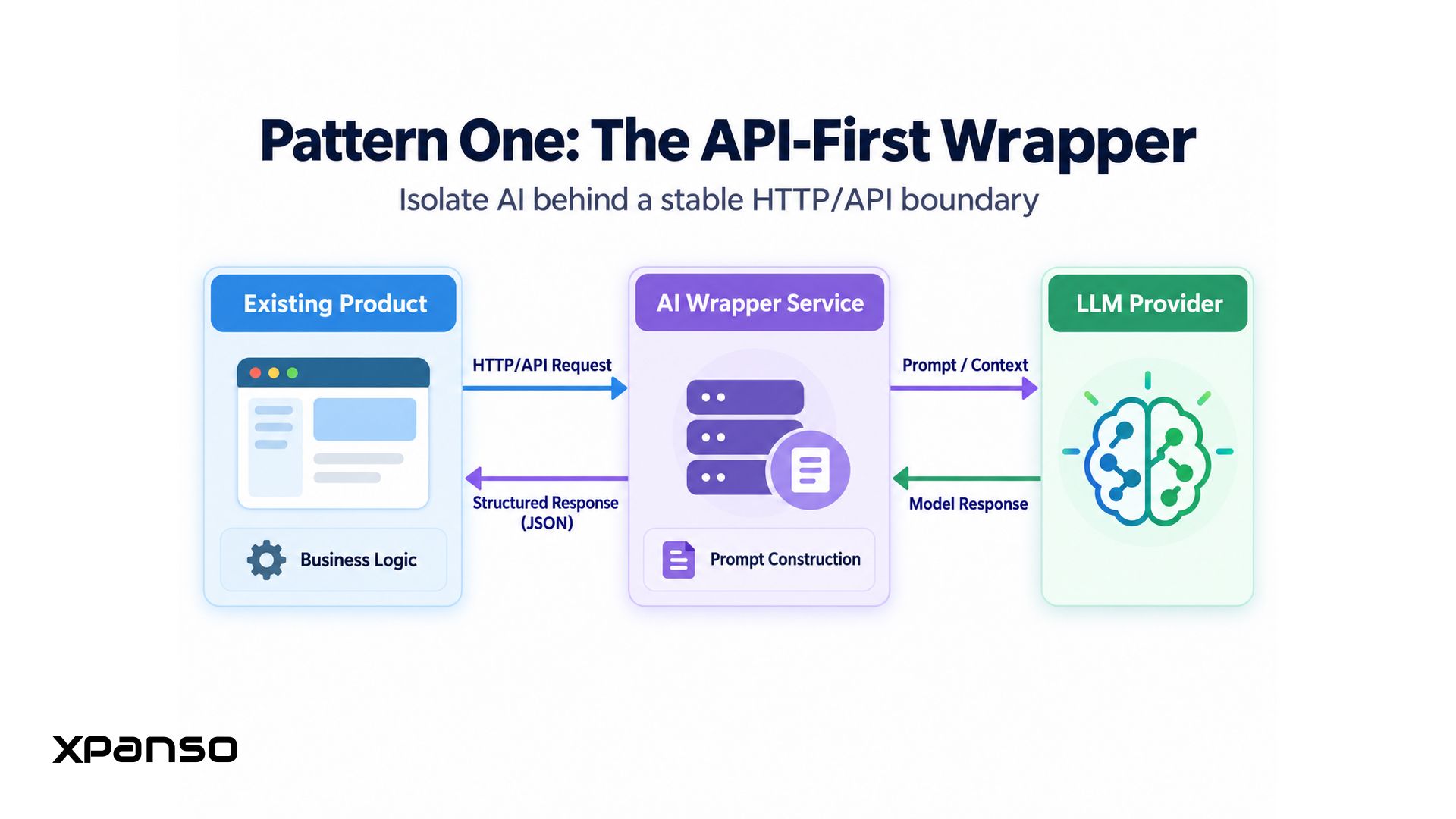
Figure 1: API-first wrapper. The existing product calls a separate AI service through a stable HTTP/API contract, keeping prompts, model integration, and inference logic outside the core application.
One of the simplest ways to introduce AI into an existing product is to put the AI capability behind a standalone service that the existing system calls over HTTP. The existing product treats the AI service like any other external dependency, even if that service is owned and operated by the same team.
The existing backend sends a request to the AI service: a prompt, a document, or a set of records. The AI service returns a structured response. The existing backend decides what to do with it. The AI logic lives entirely in the wrapper service, isolated from the core system.
The interface between the application and the AI service deserves as much attention as the prompt itself. Returning structured responses through a versioned schema keeps the AI boundary stable even as prompts, models, or inference strategies evolve over time. The application should depend on a predictable contract rather than model-specific behaviour.
Two things make this arrangement practical in ways that are easy to underestimate.
The AI service can be deployed and scaled independently from the core product. Prompts, models, retrieval strategies, and internal AI logic can evolve without forcing changes into the main application, as long as the interface contract remains stable. That separation is one of the biggest reasons this pattern works well with existing systems.
The failure boundary is also clean. If the AI service is down or returns an error, the existing system handles it the same way it handles any external dependency failure: a timeout, a fallback, or a degraded response. If the fallback path is designed properly, the rest of the product can continue functioning even when the AI capability is unavailable.
Tradeoffs
An API wrapper adds another network hop, and for anything on the interactive path that latency becomes part of the user experience. A background summary can take several seconds without bothering anyone. A feature sitting directly between a user action and the next screen usually has a much tighter latency budget.
That does not mean every AI call needs to be asynchronous. It means the team should decide deliberately whether the feature belongs on the critical request path and define the timeout, fallback, and latency budget before putting it there.
The other thing worth noting early: this pattern is only as good as the interface contract between the existing system and the AI service. A clear, versioned schema for the request and response, defined before anything gets built, saves a lot of pain later. Without it, every model update becomes a debugging session inside the core codebase.
Operational visibility is equally important. Once an AI service becomes part of a production request path, teams need to observe latency, failures, retries, and response quality just as they would for any other external dependency. Without that visibility, distinguishing between application issues and AI-related behaviour quickly becomes difficult.
Pattern two: event-driven AI enrichment
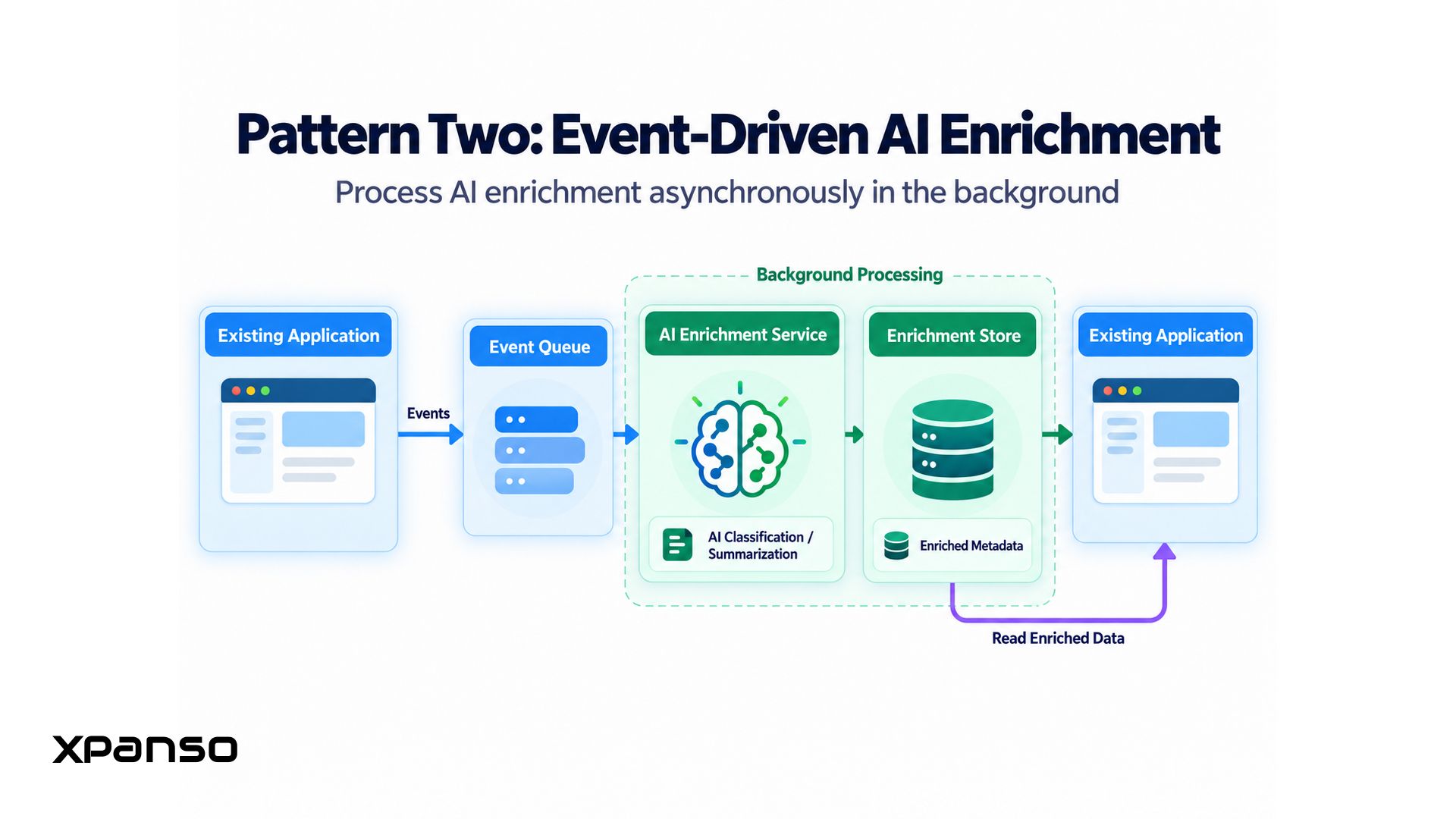
Figure 2: Event-driven AI enrichment. Product events are processed asynchronously by an AI enrichment service, with derived metadata stored separately and read back by the existing application.
Some AI value is best delivered not in real time, but quietly in the background as records accumulate. A product that handles customer tickets, content submissions, internal documents, or transaction records has a stream of data that can be enriched with AI processing without any change to the user-facing flows.
The existing system emits events when records are created or updated: a message queue, a database change feed, a webhook. An AI enrichment service consumes those events, processes the records, and writes results back to a dedicated enrichment store or directly to fields on the original records. The core system reads those enriched fields exactly the same way it reads any other data.
The enrichment service should also be designed for repeated processing. Event-driven systems inevitably encounter duplicate messages, retries, or replayed events. Processing should therefore be idempotent so that running the same enrichment multiple times produces a consistent outcome rather than duplicate or conflicting data.
This works particularly well for classification, tagging, summarization, and entity extraction. These are situations where AI is adding structured metadata to unstructured content, and where the result is useful even if it arrives a few seconds after the original record was created.
The reason to consider this pattern for bulk enrichment is that the work no longer has to follow the application's request-response path. The enrichment service can control its own concurrency, batch work where appropriate, retry failures, and process historical backfills without adding that processing time to user-facing requests.
Tradeoffs
The existing system has to emit events reliably, and many older systems do not do this cleanly today. If the product does not already have a reliable event source, introducing this pattern also means introducing some of that infrastructure. That may be a message broker, change data capture, an outbox pattern, or another reliable way to publish changes. Those pieces can be useful beyond AI, but they also add operational complexity, so they should be introduced because the workload needs them rather than simply because the AI service does.
Consistency is the other thing to think through. When a user looks at a record and sees AI-generated tags, those tags reflect the last time the enrichment service ran. For most use cases that is perfectly acceptable. For situations where the AI metadata needs to reflect the absolute current state at read time, the API wrapper pattern serves better.
Another consideration is ownership of enriched data. Some teams choose to update the original records directly, while others maintain a separate enrichment store that can be regenerated if models or prompts change. The right choice depends on whether AI-generated information should be treated as permanent business data or derived metadata.
Pattern three: gradual rollout with a feature flag layer
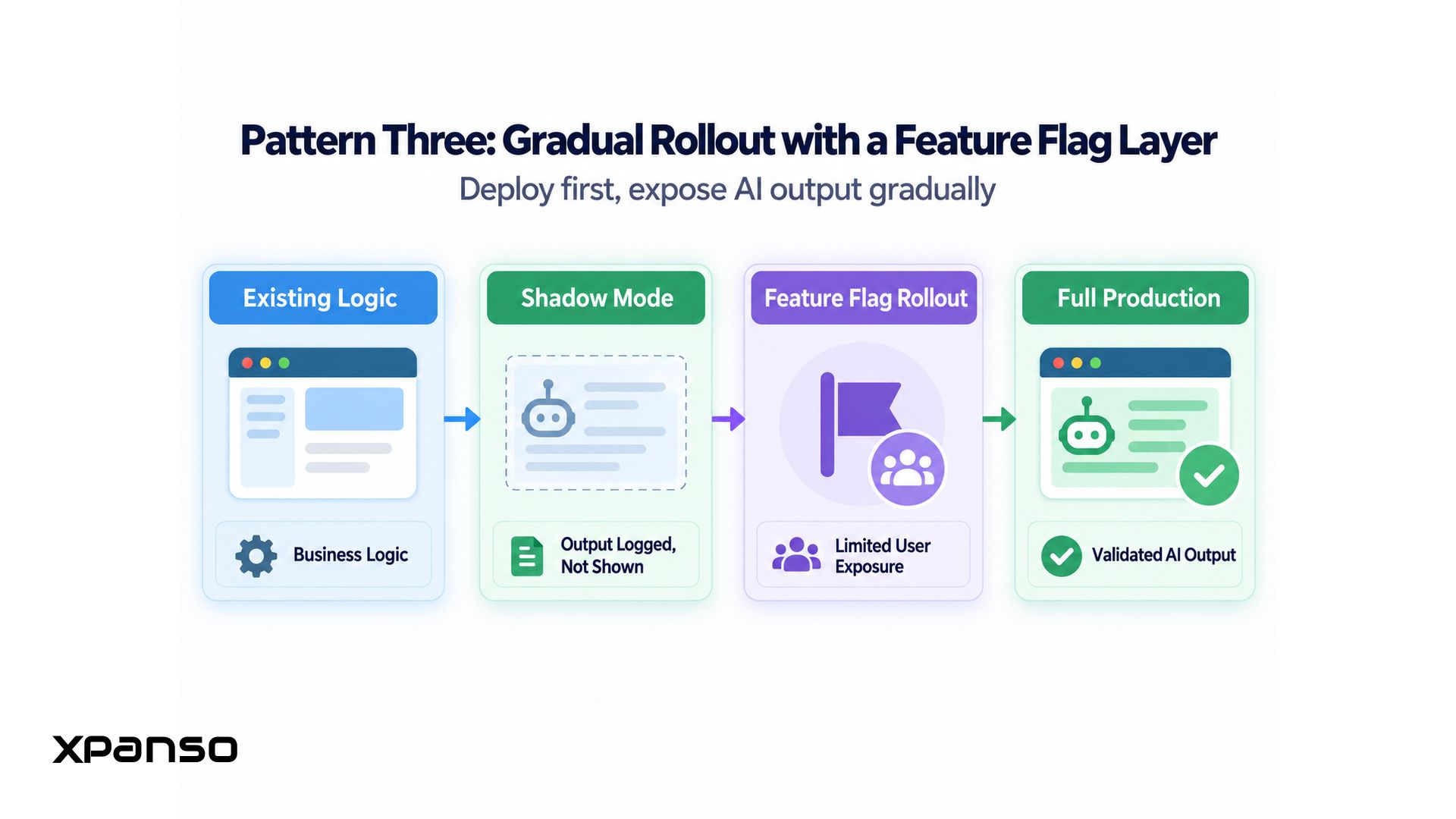
Figure 3: Gradual AI rollout. AI output moves from shadow mode to limited feature-flagged exposure before reaching full production, allowing quality to be measured before every user sees the feature.
Neither of the first two patterns fully addresses the question that teams often have but rarely say openly: what if the AI output is wrong, and real users see it?
One practical answer is shadow mode. The AI service runs in parallel with the existing behavior, processes the same inputs, and produces outputs, but those outputs go to a log rather than to users. The team reviews them, measures how often they align with what a human reviewer would expect, and uses that data to decide when to surface the results.
Shadow mode is useful because production traffic usually contains cases that are difficult to reproduce completely during evaluation. Real users bring different wording, edge cases, and combinations of inputs. Running the AI against that traffic without exposing the output gives the team a chance to find those cases before they become user-visible problems.
From shadow mode, the natural next step is controlled exposure. The AI output is shown to a small percentage of users, with a fallback to the existing behavior for everyone else. This is standard feature flag work with one addition: the flag state should be logged alongside the AI output so the team can compare outcomes between the two groups over time.
Shadow mode is only valuable when success is defined before it begins. Teams should agree on the operational signals that indicate readiness for wider rollout, whether that means agreement with human reviewers, reduction in manual effort, or acceptable behaviour across representative production scenarios. Without predefined evaluation criteria, shadow mode often becomes an indefinite experiment rather than a deployment strategy.
This is where a small evaluation set becomes useful. Before rollout starts, keep a representative set of real examples with expected outcomes and run new prompts or model versions against it. Production telemetry tells you what users are seeing today, while the evaluation set gives you a repeatable way to check whether a change made the feature better or quietly made something else worse.
Gradual rollout does not reduce engineering work. It adds instrumentation, logging, and analysis work on top of what was already planned. The value is that it separates deployment from release. The AI service can be fully built and running in production long before any user sees its output, giving the team time to verify real-world behavior without the pressure of a live experiment.
Where Each Pattern Starts to Struggle
API wrappers start to struggle when the existing system cannot provide clean, useful context to the AI service. If records are inconsistent, poorly structured, or missing important information, the quality of the AI output usually suffers as well. Improving the integration layer cannot fully compensate for missing or unreliable source data.
Event-driven enrichment becomes harder to operate when the event source is unreliable. Missing events, duplicates, retries, and incomplete payloads can cause enriched data to drift away from the source records if the pipeline is not designed for those cases. Before building the enrichment flow, it is worth understanding the delivery guarantees and failure behavior of the event source.
Gradual rollout becomes difficult when the team has not agreed on what success looks like. Without a concrete threshold for wider release, shadow mode can continue for weeks without giving anyone a clear decision. Define the evaluation criteria before the rollout begins so the team knows what evidence is needed to move forward.
Sequencing the work
The question that usually follows understanding these patterns is which one to reach for first. The answer depends on the feature being built, not on a general preference for any single approach.
- For user-facing interactive features: an API wrapper is the natural starting point. Keep the AI call off the critical path until there is real confidence in response quality and latency.
- For features that process existing data at scale: event-driven enrichment fits better. Plan the infrastructure first: message queue, change feed, enrichment store. Then start the AI work.
- For any feature where a wrong AI output has user-visible consequences: a gradual rollout layer is worth adding regardless of which integration pattern is underneath it. The two choices are independent.
One principle applies across all three: model evaluation and integration design should happen together. Early model experiments tell the team what latency, context size, output quality, and cost are realistic. At the same time, the integration architecture defines what the model needs to receive, what shape the response must have, and what failure modes the product can tolerate.
Neither side should be designed in isolation. A model that looks great in a playground may not fit the production latency budget, while an architecture designed without testing the model may make assumptions the model cannot reliably meet.
Keeping the AI Boundary Stable
The long-term maintainability of an AI integration depends less on the model than on the stability of the boundary surrounding it. Models will change. Prompts will evolve. New capabilities will replace existing ones. The surrounding application should not require significant modification each time those changes occur. A clean interface, isolated deployment, versioned contracts, and clear ownership allow the AI layer to evolve independently while the rest of the system remains stable. That separation becomes increasingly valuable as AI capabilities mature over time.
The Organizational Side of the Integration
The architecture is only part of the work. Integrating AI into an existing product also requires coordination between the team building the AI capability and the team that already owns the product.
Adding AI to an existing product requires the team building the AI capability to understand the existing system well enough to find the right seam. It also requires the team that owns the existing system to trust that the integration will not destabilize something that works.
That trust comes from keeping the boundary clear. The more the AI service behaves like any other external dependency (clear interface, independent deployment, isolated failure), the easier it is for the existing team to accept it. The more AI logic bleeds into the core codebase, the harder everything becomes to maintain over time.
The API wrapper, the event-driven pipeline, and the feature flag layer are all ways of keeping that boundary clean. That is the engineering reason to use them. The organizational reason turns out to be just as important in practice.
The takeaway
A good AI integration is not just about whether the model can produce the right answer. It is also about where that capability sits in the product, how failures are contained, how quality is measured, and how safely the feature can change over time.
Start with the lowest-risk path that still proves the feature's value. Define the interface contract early. Agree on how quality will be measured before rollout begins. Those decisions make it much easier to change models later without redesigning the product around them.
Integration patterns are ultimately about reducing coupling between rapidly evolving AI capabilities and comparatively stable business systems. Teams that establish those boundaries early gain the flexibility to improve AI over time without repeatedly restructuring the application around it.